1
Publish the finished product
Upload a bulletin, situational-awareness report, officer-safety notice, or other finished intelligence product in one secure location.
Intelligence dissemination, rebuilt
RAID gives law enforcement a secure, agency-controlled way to deliver finished intelligence products to the exact stakeholders who need them—on any device, with complete accountability.
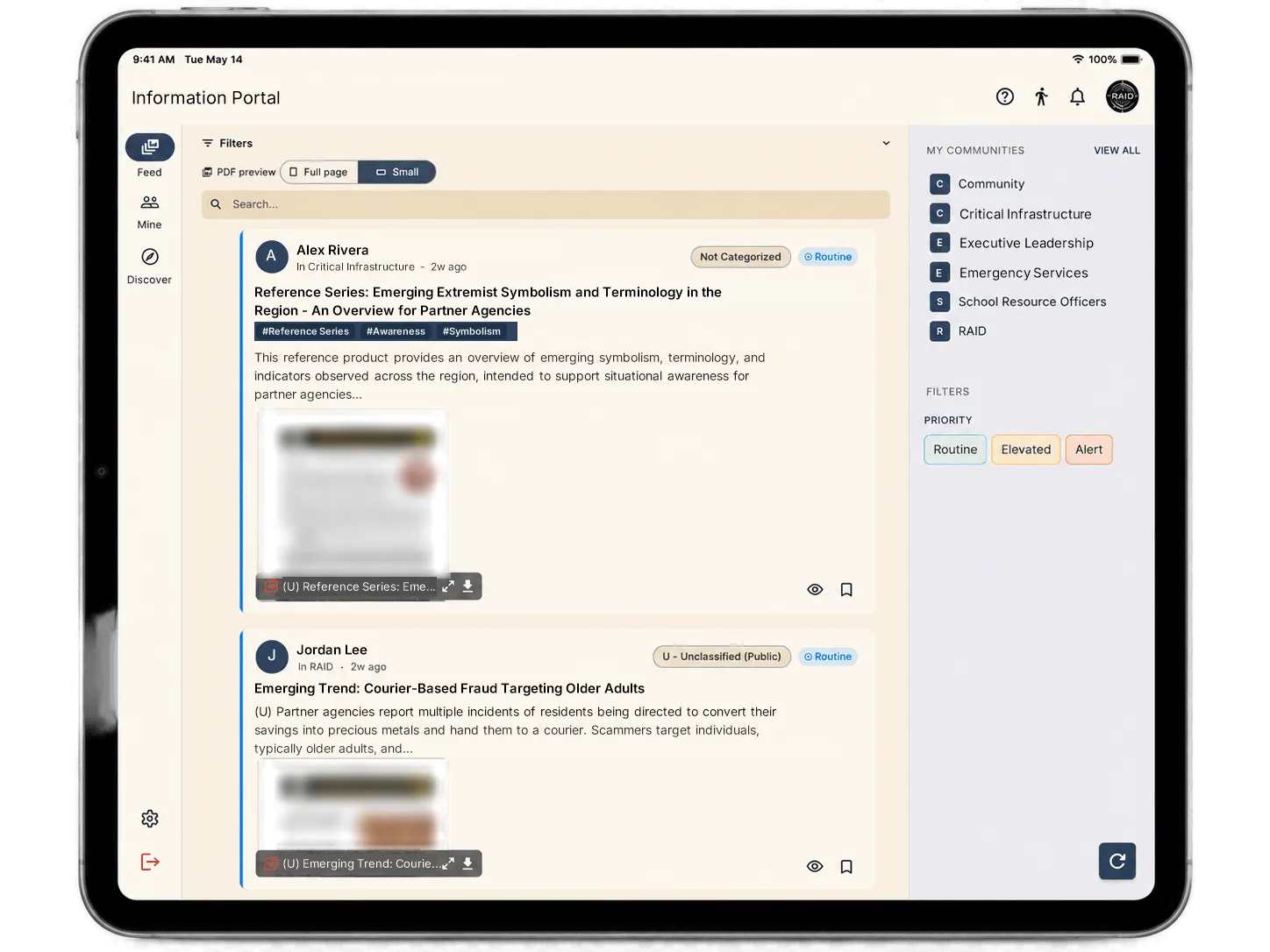
A familiar, responsive experience on any device
Purpose-built for the law enforcement intelligence mission.
The real dissemination risk“We had the intelligence product. It just never reached the stakeholder who needed it.”
The problem
Analysts invest hours creating valuable products. Then distribution depends on forwarded messages, aging lists, disconnected repositories, and no reliable way to prove who received what.
New assignments, transfers, and partner changes create gaps that are difficult to see and harder to govern.
Broad email blasts create noise. Narrow lists create blind spots. Neither creates confidence.
“We sent it” is not the same as knowing it reached the intended audience. RAID tracks readership and engagement metrics so leaders can see what was opened, by whom, and where follow-up is needed.
RAID watermarks distributed content so agencies can deter unauthorized sharing and identify the source when a protected product is disclosed.
The RAID method
RAID replaces the email-merge marathon with a controlled, repeatable dissemination workflow built around communities of interest.
Upload a bulletin, situational-awareness report, officer-safety notice, or other finished intelligence product in one secure location.
Target task forces, jurisdictions, regions, sectors, or partner groups. Every authorized member receives it—and no one outside the audience does.
See who received the product, who opened it, where engagement is strong, and which stakeholders may need follow-up.
Mission impact
RAID is designed to make every finished product easier to distribute, easier to consume, and easier to govern.
Deliver each product to the precise community of stakeholders who need it, across every participating agency.
Give stakeholders a single place for finished products instead of forcing them to search through forwarded email.
Consolidate the day’s key products into one focused read per shift, based on each stakeholder’s role and communities.
Give authorized users a mobile-first experience in the field, at a desk, or between assignments—without relying on a terminal login.
Share and receive finished intelligence products across fusion-center and agency boundaries from one controlled environment.
Understand which products land, who is reading, which communities are active, and where the network has gone quiet.
Turn one dissemination action into multi-agency reach without maintaining another spreadsheet of contacts.
Govern membership, document access decisions, and produce defensible evidence of reach and accountability.
Agency control by design
RAID is not a repurposed corporate intranet. Its access model, infrastructure, and auditability are designed around the realities of law enforcement intelligence sharing.
The outcome
RAID does not ask analysts to produce more. It helps every product create more value by reaching the right network quickly, securely, and measurably.
Common questions
RAID (Receive, Analyze, Integrate, Disseminate) is a secure intelligence dissemination platform for law enforcement. Agencies publish finished intelligence products once, target the communities of interest that should receive them, and track who opened each product — replacing email distribution lists and shared drives with a governed, auditable workflow.
Fusion centers, state police, intelligence units, homeland security offices, regional task forces, and any agency that has to reach distributed stakeholders across organizational boundaries.
RAID runs in Azure Government, US-sovereign infrastructure isolated from the commercial cloud. Every agency gets its own database and dedicated infrastructure, so no customer data is commingled. Security controls are mapped to CJIS Security Policy requirements, and access and security events are logged for oversight defense.
RAID supports Microsoft single sign-on, MFA with TOTP authenticator apps, and FIDO2 passkeys. When SSO is enabled, terminating a stakeholder’s agency account immediately revokes their RAID access.
Yes. RAID records delivery and readership per product, so command can see who received it, who opened it, which communities are engaged, and where follow-up is needed — evidence that supports oversight reporting and grant justification.
Distributed products carry agency watermarking that deters unauthorized sharing and helps attribute a disclosed product back to the recipient it was issued to.
Pricing is quoted per agency based on user population, environment, and deployment requirements. Request a demonstration and we will scope a quote for your organization.
See how RAID can give your agency a controlled, measurable dissemination network built for the law enforcement mission.
Request a personalized demonstration